

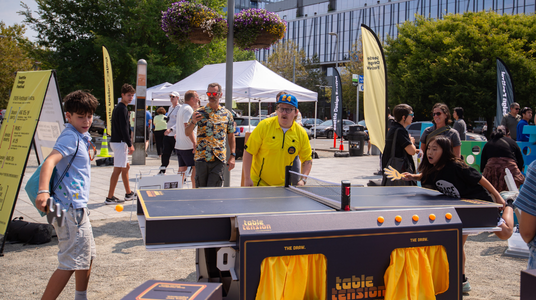
It’s a summer afternoon and you’ve stumbled upon a ping pong table in the park. You reach into a box and pull out a paddle that can only be described as a squiggle with a handle. Your opponent pulls a normal one. The ref shrugs, and you play.
This is the scenario created by our first-ever entry at the Seattle Design Festival. Two days at Lake Union Park with an interactive piece that we called Table Tension.
Why did we decide that now was a good time to participate in an event like this? Truthfully, DCG ONE has transformed over the last several years from an authority on printing to a multidisciplinary experience design agency. The Seattle Design Festival creates space for designers, organizations, and community members to explore how design can address real-world challenges. For us, it was an opportunity to bring multiple disciplines together and create a project where our unique perspective on materials and design could shine through.
The theme
The festival's theme was IN[FLUX], with four lenses on the theme. The lens that stood out to us was IN[TENSION]: how can design engage conflict, difference, and competing priorities?
Tension is a system trying to find balance and rarely finding it. In our communities and daily lives, it comes from starting conditions we don't always have control over or systems that behave in ways we didn't predict. Sometimes unexpected consequences simply occur, and you lose an advantage you had—or gain one you didn't earn.
Those are hard ideas to discuss in the abstract, but they're easy to feel when you're suddenly holding a paddle that has a hole in it.
But wait, why ping pong? Friendly competition seemed like a great way to express this concept, and we have a unique history with paddle sports—one of our original founders helped invent pickleball, specifically the paddle, so paddle sports are somewhere in this agency’s DNA. But aside from that, ping pong gave people a low barrier to entry. You hear the sound, you recognize the game, you're playing within seconds.
To really bring our concept of unfair systems to life, we created our own version of the game—Table Tension. You blindly draw your paddle from a selection of unusual shapes. The play surface behaves unexpectedly. And the moment you think you have the advantage; the table literally turns on you.
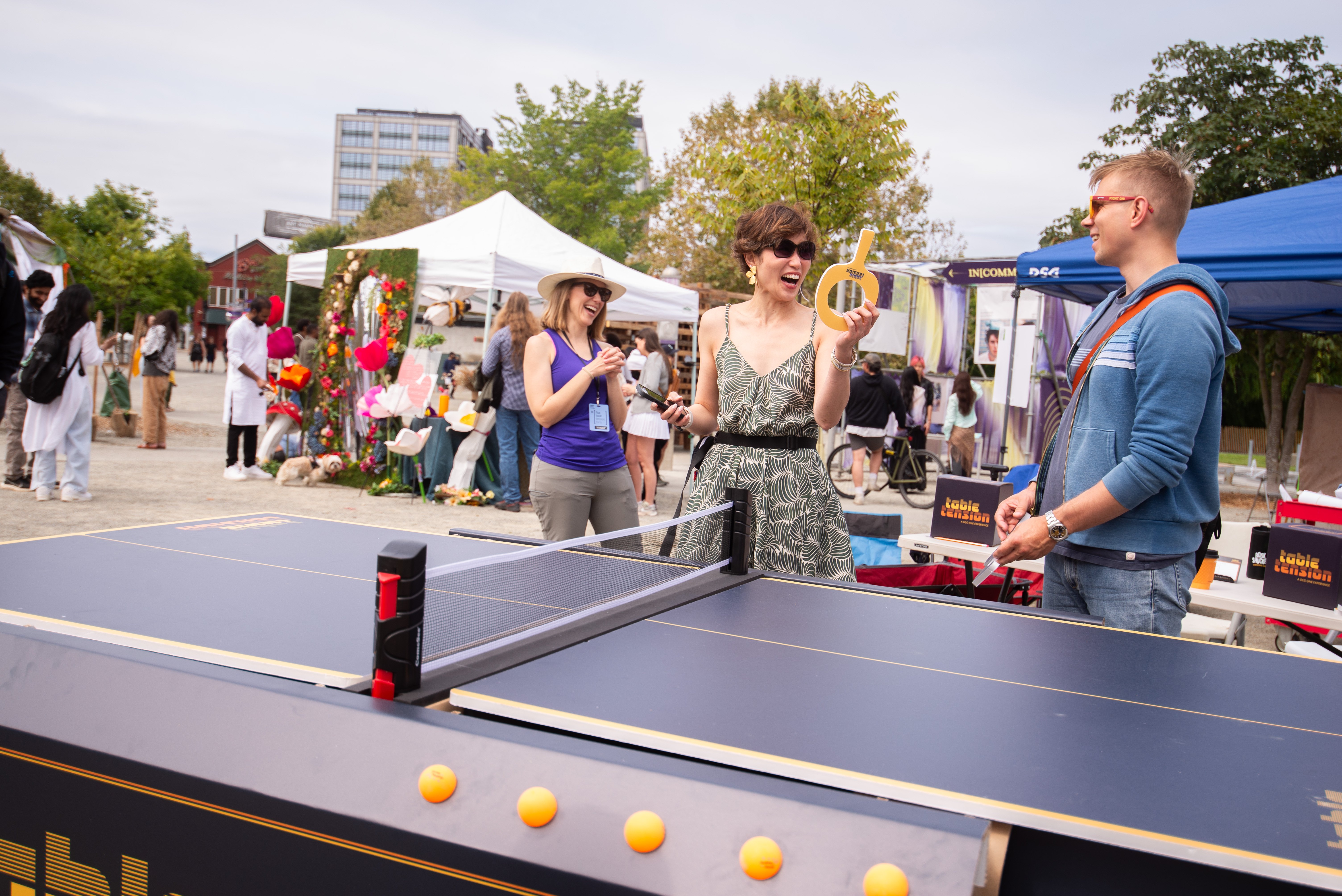
We used UX thinking to build friction
Those unknowns were variables that our design team had a lot of fun with. Most of what we do in experience design is take friction out, so an experience feels effortless. That instinct runs deep enough that it's basically a reflex across our disciplines.
This project demanded the opposite. We had to use the same thinking to manifest friction, while still making the game approachable. Too little friction and it's just ping pong—the concept is lost. Too much and people stop having fun and walk away.
That's a UX problem, and we found the skill transfers cleanly in both directions. Knowing exactly where a flow breaks is the same expertise whether you're trying to repair the break or design one on purpose.
What do you make a temporary ping pong table out of?
Aside from fabricating a structure with moving parts, we needed it built for the occasion—only two days in the park. Our structural work starts from a default: if it can be built from recyclable, fiber-based material, that's where we begin, and we work backward only if we have to. In this case, it was the perfect approach as once the pop up was over, we could recycle it.
The table is roughly 90 percent recyclable. Visitors kept asking if it was really all cardboard and were genuinely surprised by the answer.
We needed four play surfaces to rotate smoothly and repeatedly, in public, for a total of eight hours. The obvious solution would be rotational hardware that would have compromised our approach to sustainable materials. So, we 3D printed the bearings and housing in PETG which is the same family of plastic as a soda bottle, and recyclable.
How the tables turned
144 people played across eight hours over two days. Feedback cards averaged 4.9 out of 5 overall, with a perfect 5.0 on fun. Three paddles broke. The table was flipped at least 144 times.
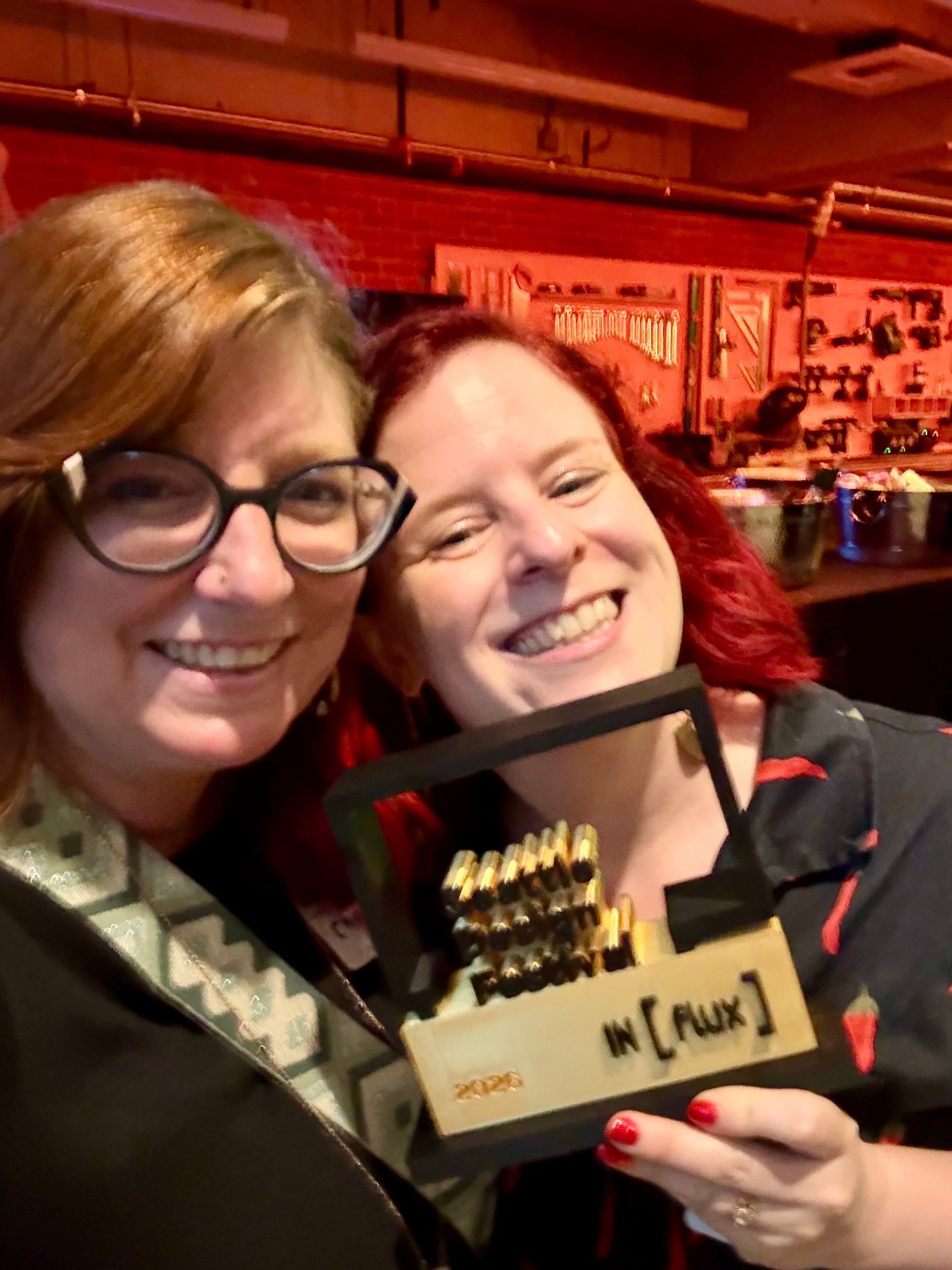
We were also honored to receive a Spirit of the Festival award for our Table Tension pop-up.
One feedback card read: "Wow, I'm so frustrated! Amazing haha."
We'll take it.
Table Tension was created by Robin Harrison, JP Flores, Annette Potter, Kelcie Brewer, Mike Lucas, David Peniston, and Morgen Masciana.